Can Bitcoin bring World Peace?

Jack Dorsey, CEO of Twitter and Square is known for being into Bitcoin. But it was when he was asked about what his hopes are for Bitcoin at The B Word conference this past summer that he gave what can appear to be an utterly absurd answer. What did Jack say? He answered, “My hope is that it [Bitcoin] creates world peace.”

When you hear something as strange as this, it is important to quickly run through the classic C.S. Lewis logic algorithm. Is Jack a liar? Is Jack a lunatic? If the answer is “no” to the first two questions, then some credence should be given to what he is saying.

Let me outline why I believe Jack is not out to lunch by hoping that Bitcoin brings world peace. Before we go there, however, it is important to build a framework on why peace is important, and why all Jesus-followers should desire peace in our world. 

Jesus was a peacemaker. He is the ultimate peacemaker, who through his own self-sacrifice provided the way for humans to have peace with their Creator. Romans 5:10 speaks of how we were once enemies of God. Jesus however, brought us peace with God (Romans 5:1), by cancelling out our debt of sin (Colossians 2:14). 

Jesus-followers are called to be peacemakers. Jesus, in his famous Sermon on the Mount declared “Blessed are the peacemakers, for they shall be called sons of God” (Matthew 5:9). We are called to live, to the best of our ability, at peace with all men (Romans 12:18). We are to pursue peace with all people (Hebrews 12:14).

Some more fundamentalist Christians will oppose the idea that Bitcoin can help bring world peace. They will say, “there can be no peace without Christ!” In some sense, they are right. One of the names of Jesus is the Prince of Peace, meaning Jesus is the “ruler” of peace. He gives it and removes it at his will in the world. 

From a justification standpoint, Jesus is the only way that people can obtain peace with God. From a societal standpoint, however, there are systems that bring measures of peace: things like just laws and judicial systems. Although they are not fundamentally religious, these systems reflect the values of Jesus by uplifting the rights of the individual. They bring equity. In this sense, these systems should be viewed as divine gifts that bring peace, from the Prince of Peace himself. Bitcoin can be seen in this same light – as a means of bringing peace – a gift from God. After all, every good and perfect gift is from God anyway (James 1:17)!

What causes war? 

The incentive for all war is the redistribution of property rights. A property right is someone’s claim upon a good, whether land, a resource, or something else. Robert Breedlove explains:

By trading the fruits of our labor with similarly self-owned others, the division of labor is attained, wealth is created, and the bedrock of civilization is constructed. All human rights are derived from the responsibilities enshrined in property rights.” – Bitcoin is the War on War

Wealth is created through the division of labour and the attainment of property rights. Violence and war stem from seeking to obtain someone else’s property by force. It’s a shortcut on work, because rather than producing an economic good that can be traded, it merely confiscates someone else’s work. James 4:1-2 explains where this stems from, touching at the core of the human spirit:

What causes fights and quarrels among you? Don’t they come from your desires that battle within you? You desire but do not have, so you kill. You covet but you cannot get what you want, so you quarrel and fight. You do not have because you do not ask God.

James appears to be speaking to individuals, but the same is true on a macro and societal level. Whether it’s fighting for oil rights, or other forms of wealth, “the forced redistribution of property motivates most warfare” (Breedlove).

Bitcoin fixes this?

Here’s the argument in a nutshell: Bitcoin may disincentivize war by making property harder to confiscate. In a future world where the majority of wealth is held in private keys, distributed in multiple locations (multi-sig) or memorized by individuals, it utterly changes the confiscation game. 

An army can invade a country and confiscate real-estate, precious metals, and other resources. But how will they confiscate wealth that is mere information?

We see this happening today in places like Afghanistan, where those who invested in Bitcoin are able to flee the country with their wealth intact – carried on a USB or in the person’s mind through a memorized seed phrase to a safe harbour. Those who held their wealth in land were not so lucky, as they cannot take it with them.

Point being, when property cannot be stolen, the incentives for war are diminished. If you know that you cannot take something from someone, even if you tried, you would probably give up before you started.

Inviolable property, then, is the only path to sustainable peace. When property cannot be stolen, the economic motivations for violence and coercion are dampened.” – Breedlove

Will this bring world peace?

For these reasons, I agree with Jack, believing Bitcoin can help to bring peace to the world, at least at a systems level. Bitcoin makes property rights ubiquitous and extremely distributed. Everyone with a cell phone can custody their own Bitcoin. By changing the way property is held, war becomes useless. 

However, a caveat is necessary. Even with non confiscatable property, human nature remains wicked. The impetus of Cain is in every man’s heart. In Genesis 4, Cain kills his brother out of sheer jealousy, knowing full well that he could not gain anything from Abel’s death. It was sheer malevolence. That same nature resides within every person to this day.

Even though full scale war may diminish, smaller scale violence may still be prevalent. In the future, it may very well be Bitcoiners who are targeted, as future Cain’s out of sheer jealousy seek not to confiscate their wealth, but to eradicate them in spite. Their logic will be that if they can’t be rich, then no one can be. We already see a hatred of the rich today in much of society, even above concern for the poor. This is the spirit of Cain.

For this reason, an even greater asset than Bitcoin is necessary. We need a place to secure our wealth where it can never be taken from us. Jesus promises us a security beyond death that lasts into eternity. Here is what he says:

 “Don’t store up treasures here on earth, where moths eat them and rust destroys them, and where thieves break in and steal. Store your treasures in heaven, where moths and rust cannot destroy, and thieves do not break in and steal. Wherever your treasure is, there the desires of your heart will also be.”Matthew 6:19-21

Bitcoin has tremendous potential to change the world and to bring an end to modern warfare. It can help provide the right incentives to bring about a more equitable and improved society. Unfortunately, however, Bitcoin cannot change the human condition. It is for this reason that the message of Jesus remains the best method for bringing peace in our world today. Not only does Jesus offer eternal security to all who come to him, but he has the ability to change one’s sinful nature. He replaces hearts of stone with hearts of flesh (Ezekiel 36:26). He makes people into the humans they were meant to be.

For these reasons, yes Jack is right: Bitcoin is a means to bring about peace in the world today. It remains to be seen how this will play out. We should all advocate for this. But if we want even longer security, one ultimately must turn to Jesus.
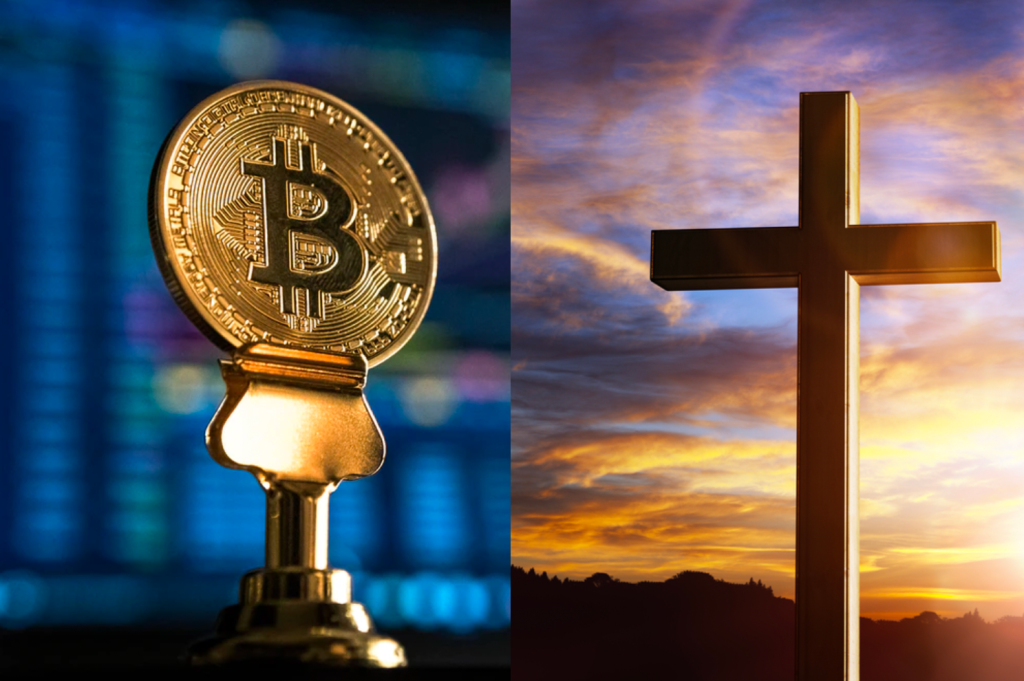
Jesus > Bitcoin

Right now, one bitcoin is worth the equivalent of an average Canadian’s yearly wage. According to the most recent year of data from Stats Canada (2019), the average annual salary for a Canadian is about $50,000 CAD. A whole year of work – of blood, sweat and tears to earn this money. But in this biblical story, an equivalent amount of wealth is spent in seconds. Some say it was wasted, but I’ll argue why this was the best possible use of $50,000. Ultimately it will show how one person decided that Jesus is better than bitcoin.

Let’s begin with asking the question of what is one bitcoin actually worth? 

If bitcoin continues on it’s trajectory of unprecedented growth (and there is no good reason why it would stop), one bitcoin will be worth millions of dollars in the future, as bitcoin becomes the world’s global store of value. I discuss why I believe this is probable in this article. Point being: bitcoin is very valuable. Holding just 0.28 bitcoin would ensure you are in the 1% club in terms of wealth in bitcoin. This would grant you immense wealth and privilege for years and decades to come.

There are various materials that humans have used throughout history as a store of value. For example, when the wise-men arrived to celebrate Jesus’ birth they gave him gold, frankincense and myrrh. Today, this would be like throwing an essential oils kit in the gift basket next to a gold soother. Neither frankincense or myrrh hold any real value today, but at the time, all three were scarce and valuable. Point being, oils and perfumes were once relied on as a store of value.

Take a look at John 12:1-8. It’s a story that took place less than a week before Jesus’ death. Jesus is having dinner with his friends, when Mary, one of his followers, takes a jar of perfume and pours it out on Jesus’ feet. The fragrance fills the room.

Mary therefore took a pound of expensive ointment made from pure nard, and anointed the feet of Jesus and wiped his feet with her hair. The house was filled with the fragrance of the perfume. – John 12:3

Now, Mary’s pound of pure nard was especially valuable – estimated to have been worth 300 denarius, which is the equivalent to about a year’s wages. This was her life’s savings! Some theologians guess that this could have been her dowry money! A dowry would have allowed Mary to be married to someone in high standing. It would have brought her security and standing in her culture. It would have ensured a brighter future. 

By pouring this out on Jesus’ feet, she is doing something which most people would consider utterly wasteful and irresponsible. Notice Judas’ comment immediately after seeing this: 

“Why was this ointment not sold for three hundred denarii and given to the poor?” – John 12:5 

This is a rational objection, is it not? This money could have been used to feed, house and alleviate the suffering of the many poor people in their society. There was no social safety net to fall upon, which is why the Bible emphasized taking care of society’s most vulnerable. 

But the next verse unveils Judas’ true motivation: 

“He said this, not because he cared about the poor, but because he was a thief, and having charge of the moneybag he used to help himself to what was put into it.” John 12:6

Unlike Judas, Jesus loved the poor. His very mission statement was to bring good news to the poor and to free the oppressed (Luke 4:18). Yet here, Jesus does something completely orthogonal to what most of us would expect. Instead of agreeing with Judas, he commends Mary, and welcomes the act of worship. 

Jesus said, “Leave her alone, so that she may keep it for the day of my burial. For the poor you always have with you, but you do not always have me.” – John 12:7-8

Jesus knew that his death was fast approaching and recognizes that Mary is doing something significant for him. She is both giving him the pleasure of a beautiful smell and preparing his body for his burial. Mary was deeply in-tune with Jesus. She knew who he was. She did the cost-benefit analysis and determined that to give Jesus just a moment of pleasure was worth more than a full year’s wage

What did this mean for Mary? By giving away what was likely the most expensive thing she owned, this greatly risked her ability to marry in the future. It left her poorer and vulnerable, because money is an insurance against uncertainty (thanks for the definition, Robert Breedlove). Through our lens, Mary was worse-off in every tangible way as a result of “wasting” a whole year’s wages. 

However, Mary’s gift demonstrates her sincere belief that Jesus is who he said he was: that he is God, and that he is a rewarder of those who seek him (Hebrews 11:6). Through her sacrificial gift, Mary displayed the ultimate low time preference. She’s setting her sights not on the next week, year, or decade. Mary believed that Jesus is the Resurrection and the Life (John 11:25). That means that where Jesus is, life is. Mary knew that to give a whole year’s wage in this life was worth it. She was aiming at attaining a glory far greater. 

Pause and think of the significance of what Mary did for a moment. Through this gift, Mary did something utterly profound: she made God happy. No one can explain how important this is as well as C.S Lewis:

“To please God…to be a real ingredient in the divine happiness…to be loved by God, not merely pitied, but delighted in as an artist delights in his work or a father in a son—it seems impossible, a weight or burden of glory which our thoughts can hardly sustain. But so it is.”  – C.S. Lewis, The Weight of Glory

Many bitcoin proponents say that the game is simple. Whoever accumulates the most bitcoin wins. In sheer financial terms, I think I agree. 

But there is something far greater than bitcoin that is worth giving everything for. Jesus brings reward not just in this life but in the one to come and is therefore superior to bitcoin. 

What’s the lesson here? Should we all sell our bitcoin and give it away to the Church or for some philanthropic cause? No, that’s not the point of this story. Like most of scripture, this story reveals issues of the heart. The key question is what do you value most?

Believe me, since taking the orange pill last December, I’ve become obsessed with bitcoin. Barely a day goes by that I’m not reading an article, listening to a podcast or watching a Youtube video about it. That is why I find this story of Mary utterly convicting. It speaks to my temptation to idolize bitcoin and reminds me of where my heart should be – focused on the one who created me, my first true love – Jesus. 

What about you? What do you value most? Through my experience, I’ve found that putting Jesus first allows for everything else to take proper priority in my life. 

My hope is that you will experience that too. 
Jesus > bitcoin.

Dave Ramsey: Right Principles. Wrong System.

Dear Dave,

I want to tell you a story.

My wife is both an amazing mom to our two young kids and a supply teacher who picks up shifts on occasion when we are looking for some extra cash. A few weeks ago, she decided she would take a shift teaching online. Schools were desperate for teachers, and my wife was getting multiple calls a week asking for her help. However, in order for her to work, someone would have to watch our two young kids. Since I work full time from home we decided that I would help the kids between my work calls, so that we could both work on the same day. 

It was a hard day. It was very challenging to attend to the immediate needs of our children while at the same time trying to both keep up with our work obligations. At the end of the day, we had the satisfaction of knowing we had earned an extra $200 and helped kids amidst a supply teacher labour shortage. It was a sacrifice, but it was worth it.

However, two days later, we were told by our friend about a COVID relief government program. The program pays people who cannot work due to their kids being home from school because in person learning is closed. The pay? $450 per week! We realized in that moment that after all that sacrifice and hard work we actually lost $250. My wife would have qualified for the $450, but by working, she became ineligible for the program. If we had known sooner, we could have just applied for the funding, had way less stress, and made more money.

Funny story right? Wrong. I find it utterly confusing and slightly terrifying.

What the government had created for us was an incentive to do nothing. They created a system where sacrifice was hindered and passivity was rewarded. What does this say about us as a culture when our incentives are reversed? Where does that lead us as a country? 

Years ago I was obsessed with your show. I read your book: The Total Money Makeover. You are known for being America’s money guy, a Christian (like me) who teaches down to earth principles related to life and money. I memorized your slogan, which can only be said with your classic southern drawl: “Welcome to the Dave Ramsey show, where cash is king and the paid off home mortgage has taken the place of the BMW as the status symbol of choice.”

Through your popular radio/youtube show, you encourage wise financial stewardship as you respond to each of your callers: “Are you thinking about taking a student loan? Don’t! Instead, go get a part time job and work hard to pay for school. Learn yourself some responsibility and a solid work ethic in the process! Are you thinking about leasing a new car? Don’t! Instead, buy an old beater that will get you from A to B securely and use the rest to pay off your debts. Are you thinking about getting a mortgage to buy a house? Well… okay, but make sure it’s only a 15 year loan and that you work your butt off to pay it off in half that time.”

Dave, your advice has been great for so many people, including me. You’ve helped thousands get their lives together and regain hope. You have rescued many from bad consumer debt and brought them into a safe haven of healthy financial habits by setting a strict budget, working hard, paying down debt and storing wealth. 

But there’s a problem, Dave. Your “no debt” program doesn’t work in our current financial system. In fact, by going your way it will mean people will stay poorer than others who work less than them. Why? Let me explain.

In our current financial system, people get rich not by working, but by using debt to buy assets. For evidence, look no further than Canadian housing prices. In 2020, the average Canadian home owner made just as much from appreciation on their house than they did from their salary. Stop and think about that for a minute. You can either work a whole year, exchanging your precious time and effort to make a salary (and in the process, you will be contributing to the overall good of our society through providing value to others) or, you can just buy a house, sit and play video games for a year, contributing nothing to society, and you will wind up in the same financial place one year later.

Needless to say, this is insane. What this says about us as a society is that getting ahead has very little to do with how hard you work, and everything to do with how well you can play the system. But wait, it gets ever more sinister!

The government is in the process of keeping interest rates low and doing something called quantitative easing. I’m not a technical expert, but I know enough to know that what this does is fill the system with more money. We celebrate because we’re getting free stimulus cheques from #DaddyTrudeau. But where is that money coming from? Answer: it’s coming from no-where. It’s being created out of thin air. Here’s the danger in that: as more money floods the economy, all money becomes less valuable. It’s like having a rare collection of Beanie Babies, only to find out that the manufacturer decided to make way more of those same Beanie Babies. Now everyone and their dog has the Princess the Bear TY, and suddenly, yours isn’t worth as much.

By printing more money two things happen: 1) The cash you own loses value. This is seen by rising prices at the hardware or the grocery store. 2) Money moves toward hard assets. People who actually want to preserve their wealth and save for their future are forced to find “rare” (or scarce) things to put their money into. Because rates are so low, they borrow at next to 0% interest and buy things like property or stocks. 

Here’s the point: Those who own assets get richer and those who do not get poorer. The rich already own assets and the poor do not. This creates and exacerbates the wealth divide. Hard working people who do not have assets, are being priced out of the housing market and falling further behind. No amount of hard work can get them ahead because work doesn’t gain wealth. More money keeps entering the system, robbing them through dollar inflation, and the money goes to the rich through asset inflation. 

So here’s the question: How does someone hold to “the same advice your grandmother would give you” and make it in this system? Dave, your advice falls short, not because the principles are bad, but because of our flawed system. Why would anyone work hard, get out of debt and save when they would end up in a better place by not working and leveraging as much debt as possible?

I’m sure you would respond by saying that I’m not accounting for risk. But what risk? We’ve already learned from 2008 that governments are ready to print themselves out of any problem. They will not choose austerity. They will choose to debase our currencies.

So in our system, no, Dave, cash is not king. Cash is trash. 

As our economy becomes more turbulent, what we need is a solid foundation. We need a pure substance that cannot be debased upon which to set our trust and put our savings. We need something to invest in that can hold and increase purchasing power far into the future. We need Bitcoin.

Dave, your principles do not work in our current fiat system, but work beautifully on a Bitcoin standard. On a Bitcoin standard hard work and savings are incentivized, not punished. I’ve heard you disregard Bitcoin because of it’s volatility when you fail to recognize that because of that volatility, leveraging is dangerous and discouraged. Hodling is encouraged.

Dave, you tell people to invest in mutual funds with a 10 year track record of earning and average of 10% or more per year. Why not tell them to check out an asset with a 10 year track record that has averaged 200% per year?

Dave, please stop dismissing the antidote to our debt problems and start seriously considering how Bitcoin fixes our monetary system. We need your voice!

Sincerely,
Hodling Jesus

Dear Christian Leader: You need to embrace Bitcoin

It is with a posture of humility that I propose what will at first sound like a crazy idea. Let me get it out of the way, and then subsequently build the case: I would like to suggest that you, your church and the Christian ministries that you support align themselves with Bitcoin. This should include: 1) educating yourself on Bitcoin, 2) offering internal education on Bitcoin to your church and/or ministry, 3) publicly accepting Bitcoin donations, 4) invest in and advocate for Bitcoin use in your community and around the world.

Why would I suggest you do such a thing? Bear with me as I explain.

What’s wrong with our financial system?

Our world is heading toward what could be one of the biggest shifts of power since the time of the Reformation, 500 years ago. Back then it was the separation of church and state, powered by a firm trust in the gospel and the God-sent invention of the printing press. Today it is the separation of state and money. Bitcoin is a Trojan horse that will undermine the current financial system – a financial system that is spiralling out of control with debt and is causing all kinds of social harm in our world.

What is wrong with the current system? From 2000 to 2020 the governments of our world have ballooned world debt from $62 trillion to $247 trillion (4x) while only growing global GDP from $34 trillion to $80 trillion (just over 2x) – see Forbes article quoting Jeff Booth. Essentially, debt expansion has doubled the pace of economic growth over the past 20 years. COVID has exacerbated the debt levels even further and this is only going to continue.

Why is this a bad thing? Proverbs 22:7 says, “the borrower is a slave to the lender.” God is not a killjoy by being against debt. He’s trying to warn us of a fundamental reality in the world: that debt consolidates power. When you become indebted to someone, you become their slave. They gain power over you. 

As world governments balloon their debt, they need to create more money to service the debt. As more money is created, asset prices go up in relation to the expanding money supply.  By printing endless amounts of money, our government has either deliberately or inadvertently incentivised people to borrow as much money as they can in order to buy as many assets as they can. The idea of working hard and saving money in order to get ahead is not possible in our culture. Why? Because the incentives are off. The clearest example of this is that my house earned more money than I did last year through my salary (due to rising house prices). The net result of this is that those who own assets benefit, and those who do not get left behind. 

In his recent interview with Carey Nieuhoff, Tim Keller identified the disappearance of the middle class as one of the biggest issues facing the church and our culture today. Keller mentioned that in our financial system (both US and Canada), labour is not as valuable as assets and that this is producing growing economic inequality. He then says that the growing economic inequality is fuelling a lot of the “political problems” in our world, and it’s only getting worse.

Economic desperation is an opportune time for populist movements to emerge. This was seen in Weimar Germany in the years preceding Hitler when they suffered hyper-inflation. When people work harder, but only to see their ability to purchase what they need decline, they become susceptible to blaming others. So much of class warfare and identity politics have their roots in economic unrest. 

Money is important. Money is our stored energy. Money allows society to function by allowing us to specialize our skills in specific ways through which we provide a service to the community. By receiving money for our work, we are able in turn to benefit from the entire market of people who poured their efforts into other things that we both want and need. Our money is akin to our stored time. Our stored time is stored life-energy.

Monetary expansion is theft and stealing is wrong. As the governments expand the money supply, it is taking money from the poor (those without assets) and giving it to the rich (those with assets). As Member of Parliament Philip Lawrence recently quoted: “inflation is a particularly vexatious economic peril that steals disproportionately from a society’s most vulnerable.” Put another way, “When our money is stolen, our labor is stolen. When our labor is stolen, our time is stolen. And when our time is stolen, our life is stolen” (Thank God for Bitcoin, 39).

How Bitcoin fixes this.

Bitcoin is a peer-to-peer digital payment system that was invented in 2008 by someone who goes by the alias Satoshi Nakamoto. In a breakthrough in computer science, Satoshi was able to create something never before seen: digital scarcity. On a macro level, Bitcoin is a digitally scarce asset that is growing exponentially (averaging 200% per year over the last 10 years). It functions as a base layer of money that is a replacement for central banks. Contrary to the inflationary money that comes from central banks, Bitcoin is deflationary. There is a capped supply of Bitcoin – only 21 million coins will ever exist. The supply is completely inelastic.

Bitcoin is fully decentralized. It runs on the most powerful network of computers in the world. There are two key elements: First, there are miners, which solve ultra-complex cryptographic algorithms in order to “mine” new Bitcoin and to process payments. Because the process is so energy intensive, miners often receive flak for being anti-environmental (although there is an excellent case to be made for its “green” potential). Second, there are nodes, which keep ledger of all transactions that have ever occurred. Although Bitcoin only needs 1 node to run, there are tens of thousands of nodes scattered throughout the globe which ensure its security. This means that the only way to stop Bitcoin from functioning would be to essentially shut down the internet… globally. Both miners and nodes continue to grow year over year, which all contribute to one thing and one thing only: securing the Bitcoin network.

Bitcoin was predicted at the dawn of the internet in 1997 in the book, the Sovereign Individual (James Dale Davidson and William Rees-Mogg). Specifically, they foresaw that cryptography could be used to make an anonymous digital form of money that would span the globe and accumulate the world’s store of value:

“Soon you will pay for almost any transaction over the Internet at the same time you place it using Cybercash. This new digital form of money is destined to play a pivotal role in cyber commerce. It will consist of encrypted sequences of multi-hundred digit prime numbers. Unique, anonymous and verifiable, this money will accommodate the largest transactions. It will also be divisible into the tiniest fraction of value. It will be tradeable at a keystroke in a multi-trillion dollar wholesale market without borders.” 

Bitcoin first became money in the infamous transaction when one individual sold 10,000 Bitcoin for two Papa John’s pizzas on May 22, 2010. It has grown organically and exponentially ever since. The inventor, Satoshi Nakamoto disappeared 10 years ago and has never been seen or heard from. This means that Bitcoin has grown without its founder and without any CEO. Bitcoin is a phenomenon. It continues to this day to grow as individuals discover it, invest in it, increase its value, which in turn garners more traction. Today Bitcoin is worth around $50,000 CAD. In relative terms, Bitcoin is comparable to the adoption level of the internet in 2005.

By being a scarce, digital, decentralized form of money, Bitcoin functions as a replacement for our current financial system. As the price continues to increase, the case becomes more compelling.

Why should Christians advocate for Bitcoin? 

Christians value truth. Bitcoin is raw truth. Every node running the Bitcoin blockchain contains the whole ledger of every transaction that has ever occurred on the network. It is theoretically immutable, and completely transparent, leaving no room for falsehood – a vast contrast to the central banks.

Christians value freedom. Bitcoin today is providing freedom all over the world. It allows people in Canada to be able to outpace house prices, so they can afford to buy a home amid inflation. More importantly, it provides people who live in countries with hyperinflation a lifeboat – a way they can store their savings and not have it confiscated through malicious governments. Furthermore, Bitcoin undermines totalitarian regimes by providing a monetary “out” from their oppressive systems. Because it is digital and cryptographic, it cannot be easily confiscated. With Bitcoin it is possible to move from an oppressive jurisdiction to an open jurisdiction and to keep your entire net-worth in a 12 or 24 word passphrase in your mind.  

Christians care for the poor. Bitcoin flips the tables on the existing powers that have created the current and increasing wealth gap. It provides an opportunity for the poor to secure financial success by allowing them to invest in something that will increase in value over time. 

Christians value equity. Bitcoin puts everyone on an equal playing field in which everyone functions according to the same economic rules. There is no special favour for those closest to the money printers (see Cantillon effect). Anyone with an internet connection can access Bitcoin.

Christians hate violence. Bitcoin defunds mass violence by aligning societies and countries to a fair monetary incentive structure. It make seizure of property far more difficult, thereby disincentivizing war (see more recent article on Can Bitcoin bring World Peace?).

Christians want to change the world by helping people know Jesus. I may be wrong, but from what I can see, most people in the Bitcoin community are atheist. However, they are genuine truth-seekers, incredibly intelligent, and very open minded – oh, and did I mention they’re really cool? If Bitcoin continues its trajectory, it is this group of early adopters who will be the richest and most influential people in the world in the coming decades. Therefore, it is imperative that we bring gospel-centred Christian voices into their world that they might know Jesus and be changed by Him. We have the opportunity: reach Bitcoiners today, change the world tomorrow (ref. Bill Bright).

Lastly, I believe Christians have the “gumption” to stand for Bitcoin. Christians (in most countries) understand what it’s like to be a cultural minority. We know what it’s like to hold to strange counter-cultural beliefs like the resurrection of the dead. We know how to stand firm on those beliefs despite the pressure coming from society. In a similar way, Bitcoin is a counter-cultural movement that takes conviction. You have to “hodl” (hold on for dear life) hard when the price swings are so great. You have to know what you own to not sell out early.

One of the greatest problems to overcome is that Bitcoin, although one of the greatest inventions of all time (think: the printing press that pushed out the Gutenberg Bible), is shrouded in a fog of meaningless alt-coins (eg. Ethereum, Dogecoin, XRP, etc). It is constantly criticized by the mass media as being a bubble on the verge of collapse due to its extreme price volatility or it is said to be harmful to society because of its energy use. But Christians understand the importance of holding onto something of extreme importance despite what others think. This is the essence of faith (Hebrews 11:1).

Much more could be said. It is next to impossible to explain Bitcoin in one article. I encourage you to learn more. Start by reading the excellent book Thank God for Bitcoin, or by reading the article, The Bullish case for Bitcoin. There are so many great resources out there, and hopefully this blog is helpful too.

Allow me to conclude.

Bitcoin is not going away. It is my belief that it will continue to grow in adoption, price and influence over the course of the decades to come. It will utterly reshape our world – our government structures, our work, and our culture. It is imperative, therefore, that Christians educate themselves on it as fast as possible so they can help make the world a better place. Too often, Christians are perceived as being laggards when it comes to bringing positive cultural change. Let’s not let this one get away from us.

Let me leave you with a quote from the great investor Ross Stevens:

“When I talked to institutional investors a few years ago I would get the question, ‘what’s the chance of Bitcoin going to zero?’ And a few years ago that was an interesting conversation. Last week a client asked me, ‘what’s the chance of Bitcoin going to zero,’ and I asked, ‘what’s the chance of Christianity going to zero?’ It’s just not… it’s left the station.” 

Please give this some prayerful consideration and do your research! If you found this helpful, I would encourage you to share this article with your church, your family or whoever else needs to hear it.

Sincerely,

Hodling Jesus

New to Bitcoin? Start here.

Just as Christianity is itself an entire field of study that you can get a whole degree in, so Bitcoin can take a while to wrap your head around. One article will not do justice to explaining what Bitcoin is and what problems it solves. That said, you have to start somewhere. In this article, we provide you with some resources and answers to simple questions that helped us get started on our journeys.

I would encourage you to set aside some time over the next few days to dive into this. Take a deep breath, bring your open mind, and take notes. Understanding Bitcoin involves a paradigm shift. Once you understand it, you’ll see why so many people have come to embrace Bitcoin as a means of preserving and gaining wealth or even see it as a major solution to humanity’s societal ills.

Start here:

The Bullish Case for Bitcoin is an excellent article written by Vijay Boyapati. He’ll walk you through the history of money and help you understand what characteristics make for good money and a good store of wealth. He’ll then help you understand Bitcoin’s market cycles and where it could go from here. If you like to listen more than read, check out the What Bitcoin Did Podcast featuring the author.

Anything by Michael Saylor (the Bitcoin evangelist) is great and his Masterclass interview with Preston Phish is no exception. Saylor is the CEO of Microstrategy who in the summer of 2020 moved his company’s treasury reserves into Bitcoin. He’s since then bought more through issuing debt and continues to buy regularly. Let’s just say he practices what he preaches.

Want to blow your mind with the potential of Bitcoin through the lens of corporations? The Ross Stevens and Michael Saylor interview from Microstrategy’s conference in February is incredible. They will help you understand the backdrop of how government monetary stimulus is causing global currencies to crash relative to Bitcoin.

Looking for something with a bit more Canadian flavour? Check out this BTC Sessions Podcast featuring Greg Foss. Foss has an educational background in engineering and worked as a bond trader with one of the largest Canadian banks. We found this to be an enlightening conversation as Canadians. One of the aspects of being Canadian is that we often get more news from south of the border than our own. Banks in the United States have been in the news a lot in the last couple decades, most notably as a result of the subprime mortgage crisis. Canadian banking is a little bit different and it was quite informative to get Foss’ insider knowledge on how that system works. BTC Sessions is a great resource for the steep learning curve that you will encounter once you decide you’d like to buy some Bitcoin. He does tutorials on both hardware and software wallets, security, and coin exchanges. As a plus, he is based in Canada and offers reviews and tutorials on Bitcoin services from a Canadian perspective.

If any of these resources left you itching for more, I can’t recommend highly enough the Saylor Series by Robert Breedlove. Breedlove interviews Saylor for about 10 hours, working through his worldview: how his background in Engineering and History of Science led him to Bitcoin. It’s utterly fascinating and worth the listen.

Another excellent resource is the Youtube channel, Trader University. They articulate the Bitcoin maximalist perspective clearly through their videos.

Let us leave you with two excellent book: The Bitcoin Standard by Saifedean Ammous is the definitive guide to understanding money and why Bitcoin is the best form of hard money.

Another book that is really hot in the Bitcoin world right now is The Sovereign Individual by James Dale Davidson and the late Lord William Rees-Mogg. Written in 1997, the authors predict the invention of a digital cryptographic “cyber-cash” (ie. Bitcoin) and explain the effects of it and the emergence of other digital forces in changing the landscape of our world. They conclude that the modern welfare state, with all its inefficiencies and ballooning debt levels is unsustainable and ripe for disruption. It’s a fascinating read.

There you have it! We recognize there are a lot of great resources out there, but even just a few of these will get you started. Before you go, let me just knock some frequently asked questions out of the way:

“Bitcoin is too expensive.”

You don’t need to buy a full Bitcoin. One Bitcoin is divisible into 100 million satoshi’s. Think of a satoshi as a penny, and one Bitcoin as a 1 million dollar bill. This means you can buy just a few dollars worth of a Bitcoin and get the same effects of owning a full Bitcoin. When people buy satoshi’s over time its called “stacking sats.”

“Bitcoin has risen so much, have I missed the boat?”

Bitcoin has gone up around 200% per year and has yet to slow down over the last decade. The potential for Bitcoin to overtake gold is real. The potential for Bitcoin to disrupt and take market share from the bond market is real. First, consider that Bitcoin is the apex predator of the monetary world then go to this visual description of the world’s money and ponder how small Bitcoin is right now compared to how big it can get.

If Bitcoin is so amazing, why are so few people into it?

Bitcoin currently has a little over 100 million adopters globally, but that is currently growing by 5-10 million a month. Most people initially dismiss Bitcoin. We did! It can sound too good to be true, so our “scam” alarm bells go off. Also, many people have been put off by its mirky history: the large drop in price after the 2017 bull run, the civil war with Bitcoin cash, and the infamous Mt. Gox hack in 2014. That said, Bitcoin has actually survived each one of these events and has always come back stronger.

Bitcoin is too volatile!

Would you rather invest in something that is volatile but grows on average at over 100% per year or invest in something “stable” that increases at 4% per year? Broaden your time horizon, look 10 years into the future and consider that if the trend continues how much your investment will appreciate.

Beware of altcoins (or “sh*tcoins”), NTF’s, and others!

The crypto world is filled with all kinds of coins that are created to benefit their creators. Don’t fall for the Dogecoins out there – even Bitcoin Cash. There is only one coin that is the world leader and will become the world’s global currency and store of value. It’s the first, best, and most sufficient – Bitcoin. Don’t fall for a false prophet. None of them are a replacement for Bitcoin. Note: there theoretically could be a use case for some of these altcoins in something other than money, but you’ve been warned.

What about Ethereum?

Bitcoin is the first ever native digital currency. Blockchain technology was invented, with the creation of Bitcoin in 2008. It is globally dispersed and truly decentralized with no CEO, and a creator shrouded in mystery, who is most likely dead. The Bitcoin blockchain has never been changed, and it has gone from being worth fractions of pennies to be worth around $75,000 CAD per coin at the time of writing (March 2021).

Ethereum was created and launched in 2013 with an ICO (initial coin offering). At this time, 70% of the Ethereum coins (Ether) in existence were purchased, making it much more narrowly distributed than Bitcoin. Furthermore, Ethereum’s source code has been changed (had a “hard fork“) in the past. For both of these reasons, we avoid Ethereum. Although we confess that we do not know too much about it, we don’t believe it is a replacement for Bitcoin as a world reserve currency. Perhaps it is useful in other ways. A short helpful video on this can be found here.

Ready to get started?

In order to buy Bitcoin you need to set up an account on an exchange. Remember, you’re trading your money for another form of currency. It’s different than investing in a stock. We recommend and use Bitbuy.ca (not a sponsor). They allow you to e-transfer money from your bank to their exchange. It usually takes less than an hour for the transfer to go through, then you can buy Bitcoin immediately. You pay fees up front when you transfer the money onto the exchange.

From here you can either keep the money on the exchange (where it has 1 for 1 insurance via Knox custody provider), or you can transfer your Bitcoin keys to your private cold-storage wallet.

The phrase “not your keys, not your coins” is the mantra for Bitcoiners who like the freedom and added peace of mind by holding their Bitcoin keys in self-custody. For this, we both use and recommend the Ledger Nano S because of its ease of use.

Another way to play Bitcoin is by investing in a Bitcoin ETF. When you do this through a TFSA, you won’t have to pay tax when you sell. In Canada there are several ETF’s listed on the TSX.

That’s it! Let us know in the comments if you have further questions or other resources to recommend. Keep Hodling!

F-U-D

Fear. Uncertainty. Doubt. There are a lot of things in the life of a Jesus follower (and a Bitcoin hodler) that will cause these feelings.

For example, I recently learned that Abraham Piper, son of the famous pastor, John Piper, has over 750,000 followers on his Bible-bashing TikTok channel. John Piper has been very influential in both my life and the lives of many of my peers through his writings and messages. To see that his son is actively trying to undermine John’s life’s work is really sad and confusing. Through his eloquent TikTok rants, Abraham is casting fear, uncertainty, and doubt upon the Christian faith. FUD like this can both cause Christians to question their convictions and strengthen a non-Christian’s disbelief.

In Bitcoin, the term FUD is used to refer to news article, tweets and other forms of anti-Bitcoin communication. Whether it’s coming from Peter Schiff, Janet Yellen or Bill Gates, there are many famous detractors. The hottest FUD in the news today involves Bitcoin’s energy use and climate-change impact. For example, the BBC recently reported that Bitcoin uses more energy than Argentina! Rhetoric like this can cause people to think that Bitcoin proponents are exploiting the world’s resources for their own greed. Although there are some excellent counterpoints available, news reports like this can cause people to write off Bitcoin without thorough investigation.

r/Bitcoin - HODL strong. Don't cave to the FUD

So for those of us hodling either Jesus, Bitcoin or both, how do we deal with FUD?

There are probably a lot of ways to tackle this, but let me give you three simple ways to prevent FUD from convincing you to sell out early.

A. Turn off the FUD.

The world is a much simpler place when you turn down the noise coming from social media and your Google news feed. Fasting from Facebook, Instagram and even main stream media can do wonders. In late 2018 I went through a season of having anxiety to the point where I couldn’t sleep at night. They were generalized worries about the world – things that I had no control over. After listening to some wise counsel from Jordan Peterson, I made the resolution to focus on the things that I can change, and worry less about the things outside of my control. Along with this came a decision to restrict my social media use. It did wonders for my soul.

The average phone-addicted person could benefit from regular breaks. A great goal to shoot for is putting away your phone 1 hour per day, 1 day per week, and 1 week per year.

Author of the Bitcoin Standard, Saffadean Ammous was asked on a recent podcast to comment on how to he keeps his resolve for Bitcoin and he said the same thing: turn off main stream media. We must be careful with this, however. It’s important that we stay connected to the world and are aware of what’s happening so that we are not blind-sided by a major event. Additionally, we want to make sure that we are not simply accumulating voices around us that will tell us what we want to hear. This is something that we’ll address next.

B. Pause and breakdown the FUD.

Early on, when I was building my conviction towards Bitcoin, my brother-in-law and I would purposefully look for FUD in order to examine it and refute it. We were wary of entering an echo-chamber where our Youtube and newsfeed only showed us pro-Bitcoin arguments. By actively searching for arguments against Bitcoin, it ensured that if we were to move forward with investing, we were doing so in an informed manner. I wouldn’t say we set out to prove Bitcoin wrong, but we did wade into it with a healthy dose of skepticism.

It’s important to do this when figuring out one’s religious views too. One of the best modern examples of investigating the claims of the Christian faith is that of Lee Strobel. Lee was a journalist for the Chicago Tribune and an ardent atheist. In the 1980’s he set out to dissect and dismantle the arguments for Christianity. He presumed he would fairy quickly be able to find the thread that once pulled, could unravel the entire system. He quickly realized that thread was the resurrection of Jesus. If he could find strong evidence against the resurrection, demonstrating that Jesus was either a fictional character or dead in the ground somewhere, Christianity would be worthless. Strobel was correct in reasoning this, given that even the Bible says that if the resurrection didn’t happen, our faith is in vain (1 Corinthians 15:12-19).

As Strobel conducted his investigation, consulting with various theologians and archeological experts, he did something completely unexpected: he changed his mind about Jesus. He came to the conclusion that Jesus actually was real and literally rose from the dead. His story can be read in his book The Case for Christ or through the more recent film of the same name (which has surprisingly good acting for a Christian movie).

I appreciate it when someone is willing to change their mind, given new evidence. In Bitcoin I see this happening all the time. Take the example of the Motley Fool, who in December of 2020 published a beauty of an article entitled: “Here’s Why I Won’t Buy Bitcoin, and You Shouldn’t, Either.” This was one of the pieces of FUD that my brother-in-law and I dissected on our journey to investing in Bitcoin.

Low and behold, just like Lee Strobel, the Motley fool changed their own minds and announced a $5 Million Investment in Bitcoin less than 3 months later! While I respect their willingness to change their mind, I’ve recently taken a “turn off the FUD” approach to the Motley Fool due to their click-bait, contradictory articles. To think that they were pumping out anti-Bitcoin propaganda while considering putting it on their corporate treasury is deceptive.

C. Stay connected to believers.

There’s nothing like a daily dose of Michael Saylor to keep your Bitcoin conviction strong. Perhaps it’s just human nature to forget why we believe what we believe. Or perhaps there is something about living with a minority viewpoint that causes our convictions to wear down over time. Either way, we need people around us who hold similar beliefs. When are exposed to their thinking, it strengthens our resolve as well.

“As iron sharpens iron,
    so one person sharpens another.”

– Proverbs 27:17

Christians need each other. It’s why Jesus created the Church – the global body of believers, each with our different strengths and weaknesses. When one of us fall, another can pick him or her up (Ecclesiastes 4:10).

In his novel, The Silver Chair, C.S. Lewis writes what in my opinion, is one of the best scenes in his entire Narnia series. He describes Prince Rilian, having just been freed from the the silver chair, deep in the underworld, along with his rescuers, being slowly subdued by the Green Witch’s enchantment. This enchantment causes them to forget their former brighter past in the overworld. It causes them to forget the sun, and even Aslan (the Christ figure) himself. Finally, it takes the sacrificial effort of their brave friend Puddleglum, who stamps out the enchanted fire with his bare webbed foot, to set the children and the prince free from the witch’s deception.

In the same way, we need friends in our lives who are willing and ready to stand for truth, even at their own expense, for the good of others. Their courage will inspire us by reminding us of the value that we hold in Christ. This is why the author of the letter to the Hebrews encourages believers to continue meeting together (Hebrews 10:25). Having a like-minded community around us reminds us of the infinite value of what we possess, so that we can keep hodling.

So what are day traders thinking? As Michael Saylor points out, those who speculate with Bitcoin have no idea what they possess. Bitcoin is an “extraordinary pristine asset” much like owning real estate in Manhattan, but entirely mobile and more secure. If you own real estate in Manhattan, you never sell it. You simply borrow money from it to live and watch as the value of the asset goes up year over year. If these Bitcoin traders actually understood the value of what they possessed, they would never sell it.

Here’s my point: in the same way that FUD tempts hodlers to sell their Bitcoin, there are things that tempt Christians to turn away from their greatest asset too. What is that great asset, which is the greatest, most valuable thing in human existence? Answer: not Bitcoin, but a relationship with God.

In Christianity the saying is true that it’s not so much what you know, it’s who you know. Knowing God and becoming a part of his family is worth everything. Christians through the ages have understood this. It’s why the disciples of Jesus refused to recant their claim of his resurrection even when faced with torture and death. They were willing to stand for the truth for the betterment of others, even at their own expense. Because they knew that their wealth in Jesus extends beyond the grave and holds promise for the age to come (see Ephesians 2:7). They didn’t sell out early, they held on for dear life.

Success Criteria

When it comes to adoption, I believe Bitcoin and Christianity have two very different success criteria for lack of a better term. In Bitcoin, “number go up” is the ultimate proof of the system working. Hodlers have had to endure times of lean and times of plenty… but it’s been mostly times of plenty, so long as they’ve held it for more than 3 years during any stretch of Bitcoin’s existence.

When the price of Bitcoin continues to rise at a rate of more than 100% per year relative to USD, it raises eye-brows. Anyone in the world with internet access can notice the trend, see where it is going, do some research, and buy in. The proof of Bitcoin becomes stronger every time more people adopt it. Through its network effect, it becomes stronger as more people buy in. In this way, hodlers become more sure of Bitcoin’s worth in real time, as the number goes up, so long as they keep their focus on a long time horizon.

Christianity, however, is not simply authenticated by numbers and adoption in real time. There are two key markers for Christianity’s proof of success. The first proof comes from Jesus’ resurrection 2000 years ago. Much like the decentralized spread of Bitcoin, the early church grew exponentially in the years after Jesus’ ascension. The growth of the Christian church is especially astonishing given that in its first 300 years it was under intense persecution.

You might think I’m over-stretching this analogy by comparing the start of Bitcoin to the start of Christianity… but I’m not the first person to notice the similarities:

“Last week a client asked me, ‘what’s the chance of Bitcoin going to zero,’ and I ask, ‘what’s the chance of Christianity going to zero?’ It’s just not… it’s left the station.” – Ross Stevens of Stone Ridge Asset Management

The second proof of Christianity will come at the “end of the age” when Christ returns. At this time, everyone who holds to a faith in Jesus will be massively rewarded, and those who refused to buy-in will suffer by the wayside. You might say, “that’s not fair! Why would Jesus reward those who trust in him and punish those who don’t?” By that same logic, is Bitcoin fair? Bitcoin rewards those who adopt it and punishes those who don’t. We seek to compel our friends and family to invest in Bitcoin because we love them and want them to succeed and not get crushed by the collapse of the fiat system. [Quick aside: there is a huge first-mover advantage in Bitcoin that does not exist in Christianity (see the parable of the vineyard). This comparison could be its own article, but Jesus is pointing out that even if you adopt the Kingdom of God later than others, you still get equal benefits because of God’s great generosity.]

So we have proof at the start and the end, but what about the meantime? As we wait for Christ’s return, Jesus hodlers have been given something that powerfully offers assurance of the value of our possession – the Holy Spirit. The Spirit is Jesus’ guiding presence in the life of a Christian that affirms in our hearts what we believe.

The Holy Spirit changes the believer, enabling them to see the “fiat system” of sin and death in our world. The Holy Spirit then enables Christians to live counter-culturally – to love their neighbours and even their enemies – because their operating standard is based in another world. This is one of the key reasons why Christianity thrived in its first 3 centuries under persecution. As Tim Keller says, “It was because the early church didn’t fit in with its surrounding culture, but rather challenged it in love, that Christianity eventually had such an effect on it.

It is our sincere belief that Jesus is worth holding onto for dear life. We also believe that Bitcoin is worth hodling far into the future. If you’re a hodler too, our hope is that whatever FUD you’re dealing with, that you’ll turn down the noise, pause and think through the arguments, and that you’ll stay connected with communities that support your beliefs. That said, perhaps you’re not convinced about Bitcoin or Christianity. If that’s you, my hope is that you’ll take some time to do some research, perhaps starting from First Principles. The truth can handle investigation – go search for it!

Real Estate vs. Bitcoin

Let me say at the outset that this article doesn’t talk about Jesus, and is therefore slightly outside of the purpose of this blog. Yet I write this article because I’m wrestling with two potential options for wealth building which are before me. The one path is tried and tested: rental real estate. The other is the new emerging market that is taking the world by storm: Bitcoin. Which of these two options is best suited to build wealth for the future? As I scoured the internet to find a decent article that fairly weighs the two asset classes I could not find anything, so I’ve decided to write something myself.

Real estate is a tried and true method for building wealth. It is where the majority of home owners keep most of their net worth (through their primary residence), and rental real estate is an excellent way to become rich. Buying a cash-flowing rental property in a good location is seen as a smart and secure investment by just about everyone, even the banks. So much so that they will lend you 80% of the cost of the property to buy it, and if you’re already a home-owner, they’ll often even allow you to borrow money from your primary residence for the down payment! You can even work the magic so that your ROI can be “infinite,” as you later pull your downpayment back out of the property through a re-appraisal and own it free and clear. Everything else that comes in is bonus.

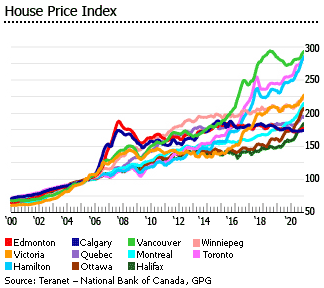
When you invest in rental real estate you earn in 3 ways: 1) Cashflow – your net income each month after collecting rent and paying your expenses. 2) Debt pay-down – your tenants are paying your mortgage such that in 25 or 30 years, you own it free and clear. 3) Appreciation – if you buy in a good location, the property value will generally go up over time, as you can see by the price chart of major Canadian cities below.

Canada house price index

Here’s the point: real estate can be very lucrative. It is a tried and tested method for gaining wealth. In fact, over the last two centuries, 90% of the world’s millionaires have been created through investing in real estate.

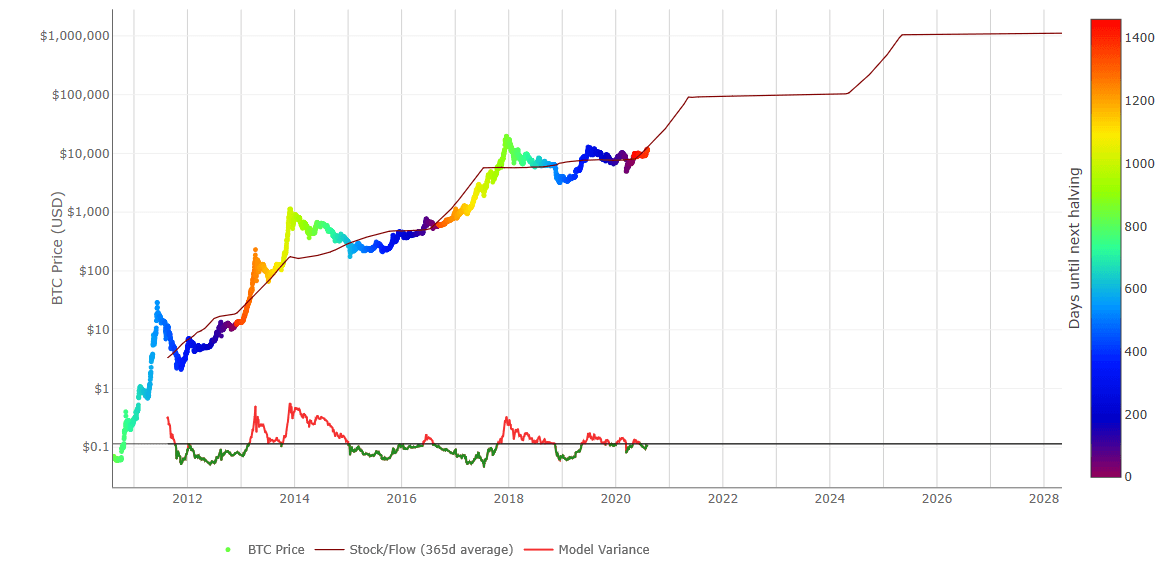
Bitcoin, being a new asset class is a much less proven way to build wealth. That said, over the past decade it has shown itself to be far and away the fastest horse in the race. So far Bitcoin has followed an upward trend that is highly correlated to its halving cycle. If that trend continues, each Bitcoin will be worth around $1 million USD sometime in 2025, as seen in this logarithmic graph below:

Bitcoin's Stock-To-Flow Model Is Still On Track (Cryptocurrency:BTC-USD) |  Seeking Alpha

But why would it stop there? If Michael Saylor is correct and we someday see a $100 trillion USD market cap for Bitcoin, each coin will be worth about $5 million USD – that’s 100x what it is today. Many will say this is a really big “if,” but let’s play out the scenario. What will be the comparison of real estate to Bitcoin if Saylor hits his ultimate price target?

Residential real estate in the world today currently comprises $355 trillion CAD. That’s the value of all the homes in the entire world, right now. The average house price in my city is about $600 000 CAD or 10 Bitcoin at the time of writing. Let’s say this is my house. This means that my humble home here in Canada represents 0.0000000017th of the total residential real estate in the world. It’s tiny… it’s a pea. And yet it’s worth 10 whole Bitcoin at Bitcoin’s current price! So I must ask myself, in a world where everything is priced in Bitcoin, should my house be that valuable?

There are only 21 million Bitcoin that will ever exist. Under a Bitcoin Standard, does it make sense that my little house would account for 10/21 000 000th of the world’s wealth? Absolutely not. Assuming a Bitcoin standard, the true value of my house today is 0.036 Bitcoin.

Another way to think of this is: I could put $60 000 into buying 1 rental property today (with partners, mortgage, etc). Or I could put $60 000 into Bitcoin today, and then buy 278 homes in the future, given Saylor’s price prediction, assuming real estate is stagnant. But even if real estate prices increases 10x, the debt is all paid down, and cashflow is solid, over that same time frame, I’m still way ahead having put the original investment into Bitcoin.

I know what you’re thinking… that’s a really big assumption that at some point in the future we will be pricing everything in Bitcoin. Michael Saylor’s price prediction is like something out of a sci-fi movie. So let me give you some thoughts on why this may not be as unbelievable as you may think. We’ll start by asking a fundamental question:

What is money?

Most of my thoughts on answering this question come from the brilliant series by Robert Breedlove where he and Saylor engage in a 10 hour dialogue about bitcoin, working from first principles. Here’s how they define it: Money is an energy network. It is the highest form of energy that human beings can channel. My money is essentially my portion of the collective achievement of human energy. I can then redistribute this energy any way I wish. This is why the phrase “money is power” is more than just a cliché.

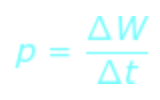
Power equals work over time

In math terms, power output is simply work done over time. Money is stored power. In the business world, the more money I spend, the more work I can get done in the shortest amount of time – ie. power. So the question is, how can I store up power for myself and my family in the future without it depreciating?

Let’s say I want to send money across time to my grandkids. Where would I put it such that it will hold its value? Let’s walk through the benefits of using the means of either real estate or Bitcoin.

Let’s say I invest $1 million into a nice house in Toronto… okay, a shack… but in a great location. What are the chances that 50 years from now that property will hold its value? There are several risks which can be summed up in two ways: counterparty risk and entropy.

Real estate has counterparty risk. How do you know that someone will want to buy your house in the future? In order for me to hold my value, Canada cannot lose a war. The house is not portable, so its fate is tied to its location. Toronto must maintain its world class standing as a city with a robust economy. If not, the market will tank and I will lose my investment. Because the house is not fungible, I cannot trade it for an equivalent house in a better location one to one. There is also the risk of hyper-inflation… which could cause real estate prices to collapse, as it did in Venezuela in 2017.

Real estate has entropy. I must pay taxes on the house. Real estate in Canada is one of the few sectors we have that are thriving, and the government seems to want an ever greater piece of the pie. What if I want to take my money out of real estate? If I want to sell my house I need to pay a 5% fee to a realtor, I need to do work or pay to make it presentable, I need to wait for a buyer, then I need to wait another 30 plus days for closing. It will cost me $50 000 and 30 days, to sell a $1 million property. I’m at the mercy of the working hours of my realtor, lawyers, and buyers in order to make all of this happen.

Bitcoin is an entirely different story. It’s grown over 100% per year since inception. On the Bitcoin network I can move $1 million for a $15 fee in 30 minutes, 24/7. It holds basically no counterparty risk and is not dependent on the market of any one country or city. It is easily transported anywhere in the world. If Canada went south, one could hop on a plane and leave, easily taking their Blockchain keys with them on a USB or in their mind through a 24 word combination.

Here’s the key point: Bitcoin has the ability to channel the entire world’s monetary energy. It’s truly distributed. Think about it… my real-estate value is dependent on people wanting to move to my little Canadian city. Contrast that with the reality that anyone in the world with an internet connection can buy Bitcoin right now in seconds. When a billionaire in Singapore, or a hedge fund in Germany buys Bitcoin, I feel the effects immediately. Already in my short experience, I’ll wake up in the morning and my Bitcoin’s value is up 8% from when I went to sleep.

Bitcoin is like the LED lightbulb of monetary energy. As I write this, I sit in my bedroom under a lamp. I’ve thrown a t-shirt over the lamp shade so as not to cast too much light on my sleeping wife. I’ve tried doing this with other lamps and have ended up with burn stains on my shirt… but not with this light. This LED lightbulb barely emits any heat. Instead it channels its electric energy efficiently into photons with very little energy wasted.

In the same way Bitcoin is a low to zero entropy monetary network. The only loss of value is through fees. Those fees, however, are paid to miners who in turn secure the network. How much of my real estate taxes go toward securing the value of my real estate? I know at least some through provision of city maintenance and essential services, but we all know governments well enough to know that it isn’t spent very efficiently.

If real estate is an incandescent lightbulb, bitcoin is an LED. In the words of Saylor, “Bitcoin is the best system in the history of the world for controlling, storing and channeling energy, and that’s why it’s destined to be successful.”

In conclusion, my investment philosophy has changed. Whereas I once believed that I would use real estate as a path to retirement, I’m now considering shifting much of my resources to Bitcoin. I still believe in real estate and think it will do well as an asset class. But I can’t un-see what I’ve seen with Bitcoin. I believe that the next 10 years will look dramatically different than the past 10 years and that my investment strategy must change to adapt to what I believe will become the new normal.

First Principles and Meritocracy

One of the most fascinating discussions about Bitcoin I’ve ever heard comes from an interview featuring Robert Breedlove and Anthony Pompliano called, “An Open Letter to Ray Dalio.” Correction: this is simply one of the most fascinating conversations I’ve ever heard about economics and philosophy.

While there are dozens of talking point, and the podcast deserves to be listened to twice or more, they touch on something that warrants this post: arguing from first principles.

When I first started looking into Bitcoin (rather than dismissing it as most people initially do) I discovered that Hodlers were asking different questions than most people. If you watch BNN or other financial news outlets looking for the latest stock pick, the driving question behind everything that is presented is this: “How do I get more money?” The financial expert wants to recommend the companies that will earn investors the most money. You, as an investor, are looking to find the next deal that will make you the most money. It’s all about making more money.

Hodlers are different. They are on a completely different wavelength from the average investor. Rather than asking how they can make more money, they are asking a far more fundamental question, which is: What is money?

“What is money?” is the question behind the question. It’s peeling back the layers to understand why we spend 40+ hours a week trading our precious time to accumulate coloured papered (we Canadians have colourful money), or to see a number go up in our bank accounts. What are we hoping that money will accomplish for us, that we are willing to sacrifice to get more of it?

Let me give you a couple of answers to this question from two people way smarter than me:

Michael Saylor comes at it from an engineering perspective when he says money is monetary energy. He then ads that Bitcoin is the only thermodynamically sound monetary system. The fiat system, on the contrary is not thermodynamically sound because it has a leak in the form of inflation. In other words, when the government prints more money, the value of your cash goes down. Bitcoin doesn’t have that problem.

Ross Stevens says money is technology. It’s a technology that enables us to take our wealth today and make it available for consumption tomorrow.

There are two key factors to consider when deciding what the best form of money is: saleability across space and saleability across time. Saleability across space means the money is mobile. Saleability across time means it holds its value far into the future.

The best forms of money are easy to transport and bring with you. A house is a poor form of money because although it can hold its value far into the future (saleable across time), it is not very transportable (not saleable across space).

On the other hand, that $50 steak I bought from the Keg last night can be brought with me anywhere (saleable across space) but no one will want to buy it from me at any point in the future (not saleable across time).

Considering what makes something a good form of money is an essential question one must ask when thinking about econonics from first principles. For a fascinating history of the evolution of money, from seashells to glass beads to gold and to fiat, check out our highly recommended book, The Bitcoin Standard by Saifedean Ammous.

Back to the podcast mentioned at the beginning. In “An Open Letter to Ray Dalio,” Breedlove is trying to convince the world’s largest hedge fund manager (Dalio) of the efficacy of Bitcoin using Dalio’s own prinicples. One of the principles that Dalio advocates for at Bridgewater Associates (Dalio’s investment firm) is that of a meritocracy.

A meritocracy is a system in which the ideas that have the most merit win. It’s a free market of ideas. It stands in contrast to both an autocratic system (in which the person or people with the most control win) or a democratic system (in which those who can rally the most votes win). Dalio likes this system as it allows people from all levels of the organization to speak into matters in order to make things better. If someone can create something that works and solves problems better than others, their idea will win. The proof is in the pudding.

According to Dalio, there are three principles that make up a meritocracy: 1) Radical Truth, 2) Radical Transparency, and 3) Believability weighted decision making.

To have Radical Truth is to have an accurate understanding of reality. When an idea is in line with reality it has merit. There are natural orders to our world that we as humans do well to understand and fall in line with. When we recognize and comply with the law of gravity, for example, we are spared from the harm of falling.

When central banks began deviating from the gold standard by lending more IOU’s than they had gold to back it up, they deviated from the truth. Once this lie was committed it was almost destined to be perpetuated. Since the US moved off the gold standard in 1971, they have been incentivized to print money into obscurity. This has been done during the COVID crisis at an unprecedented pace and has resulted in robbing from the poor to give to the rich via asset inflation. As Jordan Peterson says, “tyranny feeds on lies” (12 rules for Life, loc 2017).

Bitcoin on the other hand is the most truthful money that has ever existed. Bitcoin simply is what it is. There is no backroom of central bankers fudging numbers and inflating the supply and there can be no manipulation of the source code due to its immutability. Bitcoin has no leaks in its system, and cannot be inflated… ever.

To have Radical Transparency speaks to the openness of process. Dalio sates, “by radical transparency I mean giving most everyone the ability to see most everything.” This again is where fiat money falls woefully short of Bitcoin.

Breedlove gives the following analogy: Imagine a poker game where the hand rankings changed every few hands at the whims of the Casino. Without sound rules upon which to play the game, no player would engage for long and they would quickly leave the table. A similar game is being played by everyone living under a fiat currency. The rules are opaque. How many dollars are in circulation right now? How many will be printed in the next few years? Who gets to decide and who stands to profit at their production? No one knows except a handful of central bankers who live behind closed doors and don’t publish their record books.

Bitcoin on the other hand has a transparent and reliable rule of law. The source code and the block chain are both open for all to see. Therefore everyone who plays the Bitcoin game is knowingly playing by the same set of rules. Everyone can see that there are currently around 18 million Bitcoin in circulation, with a max of 21 million coming in the year 2140. Additionally, the rate at which new Bitcoins are entering the market is fixed by the source code. Bitcoin is radically transparent and therefore everyone can benefit equally from it.

The third component of a meritocracy is believability-weighted decision making. This one is a mouthful, but Dalio explains it this way:

“Believability-weighted decision making is a way of supplementing and challenging the decisions of Responsible Parties, not overruling them. As Bridgewater’s system currently exists, everyone is allowed to give input, but their believability is weighted based on the evidence (their track records, test results, and other data). Responsible Parties can overrule believability-weighted voting but only at their peril. When a decision maker chooses to bet on his own opinion over the consensus of believable others, he is making a bold statement that will be proven right or wrong by the results.”Dalio’s Facebook entry Feb 13, 2019

Believability-weighted decision making is what required early Roman architects to stand under new arches and bridges they built when the scaffolding was removed, often with their families. They were willing to stake their lives upon the integrity of what they had built. They had skin in the game. In fiat currency however, decisions are made by people who will be just fine regardless of the outcome of their decisions, no matter how devastating those decisions can be to others.

In the Bitcoin world, there are many people who are staking their livelihood on Bitcoin. Few examples are more striking than Justin the “Crypto Kid” who several years ago sold almost everything he had, moved into a treehouse and invested his net-worth into Bitcoin. Talk can be cheap for those with no skin in the game, but examples like Justin demonstrate how some people are backing up their talk with their wallets. As Nassim Teleb says, “Don’t tell me what you think, tell me what you have in your portfolio” (Nassim Taleb).

Radical truth, radical transparency, and believability-weighted decision making are all principles that give an idea merit.

Christianity is built upon the idea that there is a sovereign God who created the universe… time, space, matter… everything, including us humans as his crown jewel. That God did not only create all things, but is involved actively in all things. This was demonstrated through Jesus, the God-man who came into the world and lived among us, died for us, and rose again to life.

Jesus checks the criteria for radical truth because he is real. Jesus was a real person from history. And Jesus never lied. The truthfulness of his sayings have withstood the test of time for the past 2000 years. His most audacious claim, that he was God (John 10:33) was proved by his rising from the dead (Romans 1:4). History demonstrates this clearly, as mentioned by William Lane Craig.

Jesus checks the criteria for radical transparency too. His rising from the dead was witnessed by hundreds of people. When the apostle Paul gave his defence before King Agrippa in Acts 26, speaking of the resurrection of Jesus, he made the comment, “this has not been done in a corner.” What happened regarding Jesus was public for all to see, such that even this Roman King had heard about it. Today, the Bible is the world’s most circulated and most translated book, giving almost everyone on the planet has access to hear the story of Jesus in its original form. Nothing is being hidden.

Finally, Jesus checks the box for believability-weighted decision making. While Justin the Crypto Kid sold everything he had because of his faith in Bitcoin, the history of the Christian Church is full of people who gave their very lives because of their faith in Jesus. Jesus’ original disciples were martyred for their belief. These were those who lived with Jesus, saw him crucified and spent time with him after his resurrection. People don’t die for things they don’t fully believe in. There are many others throughout history who have given their lives for Jesus.

One such man was William Tyndale, who was executed in 1536 – burned at the stake. His crime? Translating the Bible into English. In Tyndale’s time, the official language of religious practice was Latin, but the common tongue of his home, England was, well, English. The authorities were more than content to keep the population in the dark regarding the content of the Scriptures, but Tyndale was a firm believer in “decentralizing” Christianity and getting the Bible into the language of the people. Today, I have a Bible in my native tongue largely because of the sacrificial effort of William Tyndale. You can read more about him in the excellent book, 131 Christians Everyone Should Know.

It is important when seeking to learn something new to ask the hard questions. When it comes to Bitcoin, one such question is, “What is money?” When it comes to Jesus, the question being asked are, “What is life? Why am I here?” Engaging in these kind of questions can help us understand reality better, and hopefully, align ourselves to it for our own good and the good of others.

PS. If you are looking to explore questions of life, faith and meaning, may I suggest finding a local Alpha group in your community or online. Alpha is a free course designed to explore these questions in a safe and fun discussion-based setting. We highly recommend it.

Is Bitcoin 100% faith?

I was watching an interview on Bloomberg with Jeremy Grantham this week where he was predicting a market crash on the near horizon. At one point late in the show he was asked about Bitcoin and make this doozy of a statement:

“Bitcoin is 100% faith. Come the next market phase where faith is at a minimum, what do we think will happen to a stock whose entire reason for existence is faith and nothing but faith?” – Jeremy Grantham (GMO Co-Founder & Chief Investment Strategist)

When I heard this comment it brought me back to a conversation I had with a random guy in the men’s locker room at my gym. He introduced himself to me by saying, “My name is Adam, so unfortunately I’m named after a character in the Bible.” This one of the strangest introductions I had ever heard. I was curious to know more. So, I revealed my cards, telling him that I was a Christian, and we proceeded to engage in some of the well-trod Atheist-Christian banter points.

“Science is based on evidence, while Christianity is based on 100% blind faith,” he commented. By this point we had left the gym and were walking together. As we crossed a street I asked him, “Did you have faith that the cars would stop for you just now?”

What I was trying to get Adam to realize is the same thing that Grantham failed to recognize: that faith has relevance in every area of life. Faith is a synonym for trust. Do you have faith that the sun will rise tomorrow? Of course you do, based on its track record and your understanding of how the solar system works. Do you have faith that Apple stock will continue to rise over the next 10 years? Perhaps, given the company’s track record, popularity, sales, R&D, etc. It’s less sure than the sun rising, but it’s probable.

In investment terms, your faith is expressed by where you put your money. You put the most money into your highest conviction stocks, because you trust them to appreciate and/or pay you a dividend. The higher your trust, the greater your investment. In this sense, faith is your certainty that your expected outcome will be realized. It’s an individual decision, based on people’s varying degrees of information.

Another way to think of this is by visualizing trust and verification on a spectrum. The more evidence we have that something is true, the needled swings away from pure trust toward verification. The more evidence I have that something is true, the more weight I will give that thing. I bought my house because I had faith that 20 years in the future it will be worth more than when I bought it. It was a step of faith based on evidence, and so far my thesis paying off pretty well.

What Grantham is essentially saying is that people who trust in Bitcoin are not basing their investment on reason. They are merely speculating, hoping that someone behind them will pay more for Bitcoin in the future. But are they? I would argue that Grantham is being dismissive without doing any of the hard cognitive work of understanding Bitcoin.

So, let’s get to the meat and potatoes. What are some good reasons to invest in Bitcoin? Let me just name a few:

Bitcoin is an uncorrelated hedge. According to Chamath Palihapitiya, Bitcoin is a monetary system that is completely outside of the current world fiscal system. Therefore, it’s worth having a small percentage in every portfolio in case of a global market crash as a form insurance.

Bitcoin is gold 2.0. Gold has been used as a currency and store of value for thousands of years because it holds great properties (see the linked article). One of those properties is that it has a high stock to flow ratio. Every year only 2% more gold is extracted from the earth (flow) and added to the global market (stock). This keeps the supply low and therefore, the value high. Bitcoin, by comparison, will eventually have an infinite stock to flow, making it incredibly valuable.

Bitcoin is an asymmetric bet. The potential of Bitcoin to completely undo and replace the current monetary system is real. Therefore, the risk-reward is heavily in favour of owning it compared to not owning it.

There are many more great arguments for Bitcoin, each of which can be debated. There are potential drawbacks of Bitcoin as well. My point here is that in order to determine Bitcoin’s validity you need to do the hard work of research. Grantham is being lazy by dismissing it as “pure faith” without explaining why.

The same could be said for Christianity. To dismiss the entire system as blind faith is failing to do the research.

What are some good reasons to “invest” in Jesus? Let me just name a few:

The Bible is a credible source. When applying the practice of textual criticism to the New Testament, we find it to be far and away “the best attested works of literature in the ancient world” (Grant & Jerome). We no longer have the original source – the actual documents which the Biblical authors wrote (the autographs), and therefore must look to the copies of it that have been passed down over time (manuscripts). We have an abundance of these manuscript, from various locations and times. By comparing these manuscripts to each other we can accurately discern the commonalities and derive with a very high probability what would have appeared on the original autograph.

Jesus claimed to be God in the flesh. If the Bible is accurate then Jesus’ words and actions depicted therein need to be taken seriously. Jesus made it clear to the audience he was speaking to that he thought himself to be God. He validated his claims through miraculous works and ultimately through rising from the dead. Therefore, he should be taken seriously.

Jesus is an asymmetric bet. Pascal’s Wager demonstrates the logic here. Since Christianity promises the infinite reward of eternal life, Pascal believed that it was worth it to stake his life on the Christian faith. Or, as legendary author C.S. Lewis once said, “Christianity, if false, is of no importance, and if true, of infinite importance. The only thing it cannot be is moderately important.” In other word, the risk-reward highly favours trusting in Jesus.

Back to Bitcoin.

Here is one of the greatest ironies of Grantham’s statement: Grantham is calling a financial system based on 100% verification and 0% trust… pure faith. He fails to do the hard work of analyzing what Bitcoin actually is, and dismisses it out of hand. He fails to recognize Bitcoin’s superiority as a currency and store of value to the current monetary system, instead advocating for people to sell out of positions and hold fiat cash (cash that is losing 15% a year, according to Michael Saylor).

Whether you’re evaluating Bitcoin or Christianity, the only way to move forward with integrity is to get your hands dirty and do the research. Take on a posture of learning, weighing the pros and the cons, making sure you listen to advocates from both sides. Only then can you, as a reasonable person, arrive at a conclusion and decided what to actually do about it.

What is HODLing?

You may have heard this strange term related to Bitcoin. Where does it come from? Today we’re going to explain what HODLing is and attempt to explain its equivalent when it comes to faith in Jesus.

Wikipedia defines HODLing as follows:

“Hodl (/ˈhɒdəl/ HOD-əl; often written HODL) is slang in the cryptocurrency community for holding the cryptocurrency rather than selling it. … A person who does this is known as a Hodler.”

The term HOLDing first appeared on a reddit page in December 2013 by an apparently inebriated user who wrote a typo in the subject saying, “I AM HODLING.” Bitcoin buffs have run with this, and today use it as a slang for “Holding On for Dear Life.”

In the Bitcoin world, there are essentially two types of people: Hodlers and Speculators.

A Speculator is a person who buys an asset, like Bitcoin, in the hopes that someone else will buy the asset for a higher price after them. They can then sell off the asset at the higher price and pocket the profit.

A Hodler is someone who, as the name entails, has no interest in selling Bitcoin. This person will hold on for dear life regardless of whether the price skyrockets or falls. Why is that? The reason is that a Hodler has experienced a paradigm shift.

Here’s the logic in a nutshell. When we work, we exert energy and are then reimbursed in the form of a paycheque. After paying for necessities such as food, shelter, etc, the leftover “monetary energy” is put into savings or investment. The hope is that by accumulating “monetary energy” in this way, you can store up wealth to the point where you will not have to work anymore (retirement) or that you’ll have enough to pass on to others to give them a better life. Saving and investing is a way to transfer the energy you spent working into the future to allow yourself and others more time and freedom. You can thank Michael Saylor for his influence in helping us understand the idea of “monetary energy.”

Here’s the problem: where can you put your monetary energy to ensure that it will either appreciate or at least hold its current value?

Should you save? Currently our fiat (ie. government) currency is dissipating at at least 2% per year, according the government’s target inflation rate. But the real interest rate, as Saylor would argue, is probably more in the 15-20% range. This means that half of your monetary energy will be gone in 3.5-5 years! Sure, the amount of money will be the same, but it’s purchasing power will have decreased by half.

Should you invest? Putting your monetary energy into real estate, bonds or the stock market has traditionally been a great way to hedge against inflation. If a stock can return you 10-12% a year, that’s often been thought to be a high return. But, if Saylor is correct, and real inflation is up to 20% a year, most stocks simply cannot keep up. And let’s not even start on bonds, of which many are yielding negative interest rates.

What about real-estate? I have a soft spot for real-estate, having enjoyed being an investor in the space for the past number of years. It’s a lot of hands on work, but the returns generate consistent cash flow. The real money, however, is made in asset value appreciation. Where does this come from? Inflated asset prices are a result of lower interest rates – interest rates which are decided by a central bank. My home is worth far more now than 5 years ago, partially from natural consequences (low housing supply and high immigration into my city), but also due to the government’s alteration of the system through lowering interest rates. In the process, the government goes into ever more debt, which it can only pay off through taxing citizens or through more inflation. The question becomes, how long can this go on? What if the government gets to a point where it cannot bay back its debt? If this happens the whole system is in jeopardy (hear Greg Voss’ argument on this Your Life Your Terms Podcast).

Enter Bitcoin. A Hodler assesses their options for where to put their wealth (ie. their “monetary energy”) and comes to the conclusion that there is nothing within the current system that can securely hold it. It’s all a leaking bucket. Bitcoin on the other hand, is arguably the best money system created, in that it holds the best properties of what money should be (see Vijay Boyapati‘s Bullish Case for Bitcoin chart comparing Bitcoin, Gold and Fiat). Bitcoin, by its nature is deflationary not inflationary. This means that it theoretically will become more valuable over time. Based on its track record of an average annual return of about 100%, this seems to be playing out.

So why are those who bought in early not simply cashing out now and taking their profits? Some may be, but true Hodlers are only taking out what they need. Think about it. What else would they put their wealth into? If all other forms of currency are leaky sieves, why take your money out and put it into something that is sure to lose value? In fact true Hodlers are relatively unconcerned about Bitcoins price compared to USD, since they see fiat currency as a fledgling liability. Instead, they actually have come to think in Bitcoin (ie. how much Bitcoin does that car, house, or banana cost?).

Hodlers believe that Bitcoin is a force to be reckoned with. Because of what Bitcoin fundamentally is, it will take over the current monetary system, and Hodlers want to be there when that happens. For this reason they hold on for dear life. Where else would they go?

The exclamation, “where else would I go?” was made by one of Jesus’ disciples in the gospel of John chapter 6. The story goes that Jesus said some things that were, well, let’s just say hard to swallow (pun intended). Because of this, many of Jesus’ followers decided to jump ship. In investment terms, there was a harsh correction. It was in this moment when Jesus turned to a smaller group of his students and asked them if they wanted to stick around:

“You do not want to leave too, do you?” Jesus asked the Twelve. Simon Peter answered him, “Lord, to whom shall we go? You have the words of eternal life. We have come to believe and to know that you are the Holy One of God.” (John 6:67-69)

Jesus’ disciples were Hodlers. They didn’t care about the volatility of the market and the sway of public opinion. They had become convinced that Jesus was worth holding onto no matter what. They believed that this Jesus, because of the evidence they had seen, was going to be of infinite importance one day – even if most people didn’t see it yet.

The same is true for for Jesus Hodlers today. Public opinion will sway, but Hodlers won’t sell out because they have their eyes fixed on the future payoff. As another Jesus Hodler and evangelist once said, “I consider that our present sufferings are not worth comparing with the glory that will be revealed in us” (Romans 8:18).

Christianity has experienced a lot of market volatility. Whether its famous Christians falling from grace due to sexual scandals, or false representations of Jesus purported by people who hold “Jesus Saved” signs while attempting to overthrow democracy, the brand image of Christianity is in constant flux. True Hodlers, however, just as with bitcoin, come back to the fundamentals to determine who Jesus is, whether or not what is said about him in original sources is true, and then base their faith upon those claims. To do otherwise can result in the same mistake many have made of selling out too early. As discussed on the What Bitcoin did Podcast the one thing worse than losing your investment could be that you sell out early on something of infinite worth.